
Building trust and improving team performance
Does your team avoid difficult conversations? Perhaps people hold back their opinions, meetings drag on or decisions take too long. The manager may carry all the responsibility while everyone else gets on with their own work.
Every team brings together people with different fears, egos and priorities. Without trust, people steer clear of uncomfortable topics, conversations become repetitive and important work goes unfinished.
“This matters especially in a leadership team. When trust and focus are missing at the top, the effects reach the whole organisation.”
Eero Sikka, leadership coach and trainer
Patrick Lencioni describes great teamwork as a lasting competitive advantage. When people pull in the same direction, even difficult markets and strong competitors can be navigated. Leaders tend to recognise the value of teamwork yet doubt whether it can actually be achieved. It takes courage and discipline to address the patterns that keep a team from working well.
Five questions to ask your team
- Do people state their opinions openly and engage in lively debate?
- Are meetings interesting and productive?
- Do discussions end with clear decisions and specific action plans?
- Do colleagues challenge one another’s ideas, plans and actions?
- Do shared results matter more to everyone than individual rewards or performance?
Even strong teams need to revisit these questions. Any answer of “no” gives you a place to start.
Assess your team
A short questionnaire based on Patrick Lencioni’s The Five Dysfunctions of a Team helps identify where your team has the most room to grow. The results cover all five areas. In the workshop we explore each one and agree on concrete actions.
Download the team assessment in Estonian (PDF). An online version is planned.
The team workshop
I run a practical one- or two-day workshop based on Lencioni’s model. I have used it with hundreds of teams in Estonia and across Europe. Teams learn to shorten circular discussions, reach decisions sooner and share responsibility for results. The work requires candid conversations and follow-through.
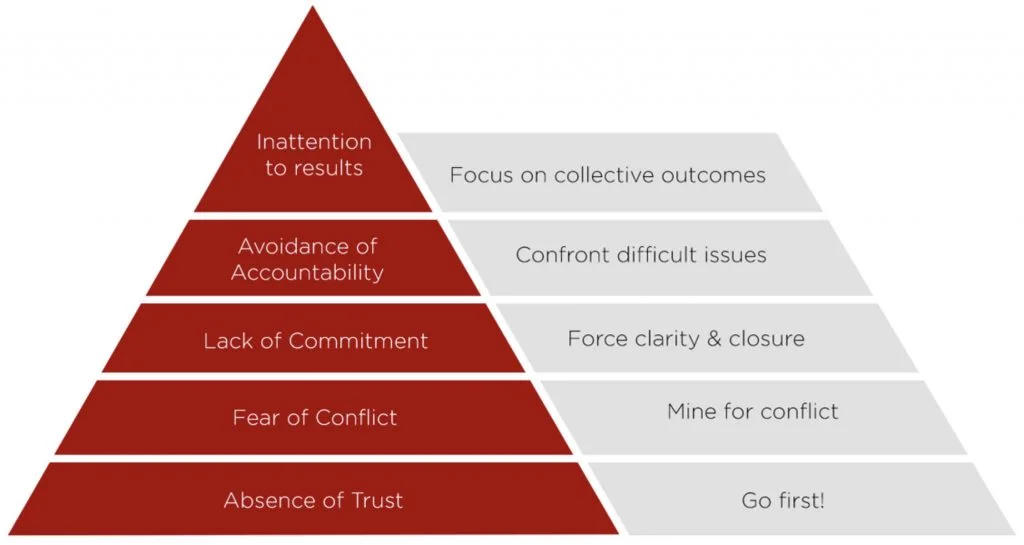
Five obstacles we work through
- Absence of trust. People are reluctant to speak honestly about mistakes or problems. Relationships stay superficial and decisions are made with incomplete information.
- Fear of conflict. Meetings lose energy as people avoid difficult subjects. Real problems remain unresolved.
- Lack of commitment. When people have no opportunity to express a view, it is difficult for them to support a decision or take responsibility for carrying it out.
- Avoidance of accountability. People let commitments slide. Colleagues hold back and leave the manager to follow up with everyone.
- Inattention to results. Individual priorities take over and the team loses sight of what it set out to achieve together.
What happens during the workshop?
A team shares a purpose, the benefits of success and responsibility for achieving it. Often that means a group of four to six people who are willing to put the group’s interests ahead of their own. Working in the same department is only the starting point. During the workshop, people practise the collaboration they need back at work.
- Explore the five dysfunctions together and complete the assessment.
- Identify the team’s strengths and weaknesses.
- Share personal histories to get to know one another. Where appropriate, participants complete a DISC, MBTI, Belbin or similar assessment beforehand and discuss it with the group.
- Agree on the behaviours people expect of one another.
- Decide how to record clear decisions, turn them into agreements and commit to carrying them out in everyday work.
- Discuss organisational clarity and agree on the team’s shared goal.
- Explore ways to hold one another accountable.
- Give each person feedback on their strengths and the challenges colleagues see.
- Agree on next steps.
We usually meet again three months after the workshop to review progress.
What should change?
The aim is greater trust and openness, more honest debate and faster decisions. Clear agreements help people commit and make accountability a team responsibility. With fewer internal tensions and stronger cooperation, the team can devote more of its energy to the results that matter. Over time, the way the team works together becomes something that distinguishes the organisation.
Client feedback
“If you see that your desired organisational changes are not happening as they should, call Eero for help!”
 Igor RõtovCEO, Äripäev
“If you’re looking for more organisational clarity and execution speed in what matters most, then I recommend Eero for help. In collaboration with Eero the bottom-line results really do start improving, but it requires that you yourself as a leader are up for the challenge”
 Valdur LaidCEO, UG Investments · Director General, Estonian Tax and Customs Board
“Eero helped me understand how I had become the glass ceiling slowing down organisational growth, helped me overcome it and to stay in top shape by doing that. A powerful experience, which I can really value now after having experienced it.”
 Ats AlbreBoard member, Nortal
“Eero has helped me in my work over the years – at Telia, e-Residency and now at Pactum. Each time the topic was different. His style suits me: a good balance of theory and practice.”
 Kaspar KorjusCo-founder, Pactum
“My leadership team operates across five countries and five nationalities. Eero helped steer our strategic discussion as a captain to a successful outcome within the designated time. We clarified our focus, the most important thing we want to reach together.”
 Karoli HindriksFounder, Jobbatical
“Company values can be an abstract topic. There is a risk that people meet, discuss them and leave none the wiser. We were able to focus on the substance while Eero guided us firmly through each stage of the process to a logical conclusion.”
 Mart TõevereCEO, Click & Grow
Frequently asked questions
Is the workshop only for senior leadership teams?
Any team that wants to build trust, gain clarity and focus on shared goals can use it.
How large should the team be?
Four to six people is often a good size. The essential feature is a shared goal and mutual responsibility for achieving it.
What can change in one or two days?
People can begin to speak more openly, develop trust and reach clear agreements. The follow-up meeting three months later helps the team review how those changes are working.
How does this differ from a team-building event?
We work directly on trust, commitment and shared results. That sometimes involves uncomfortable conversations and requires people to follow up afterwards.
Would reading Lencioni’s book cover the same ground?
The book introduces the model. The workshop gives people the opportunity to apply it to their own working relationships. I often recommend that leaders read the book beforehand.