Over the past ten years I have worked with hundreds of organisations in different countries to clarify their strategy, set goals and follow through on their priorities. Organisational performance depends on motivated, engaged people. Gallup’s research shows that only 20% of employees in Estonia are truly engaged, 65% are disengaged and 15% actively work against their organisation. Pay, performance bonuses or an annual summer gathering alone cannot create genuine motivation and commitment. People need meaning and clarity. They want to understand the organisation’s purpose and direction and how they can contribute. Their immediate manager naturally has the greatest influence on that understanding and engagement.
A shared purpose and a clear strategy help people pull in the same direction. This may sound like common knowledge, but in my experience it is far from common practice, in Estonia or elsewhere. Many employees are unfamiliar with either their organisation’s long-term strategy or its short-term priorities. One of the biggest challenges is to be specific. The leadership team needs to agree on what it means and communicate it in a way that leaves little room for conflicting interpretations. I have repeatedly seen small uncertainties at leadership level become significant problems several levels down when it is time to act. The cost can be considerable in lost revenue, additional expense or employee satisfaction.
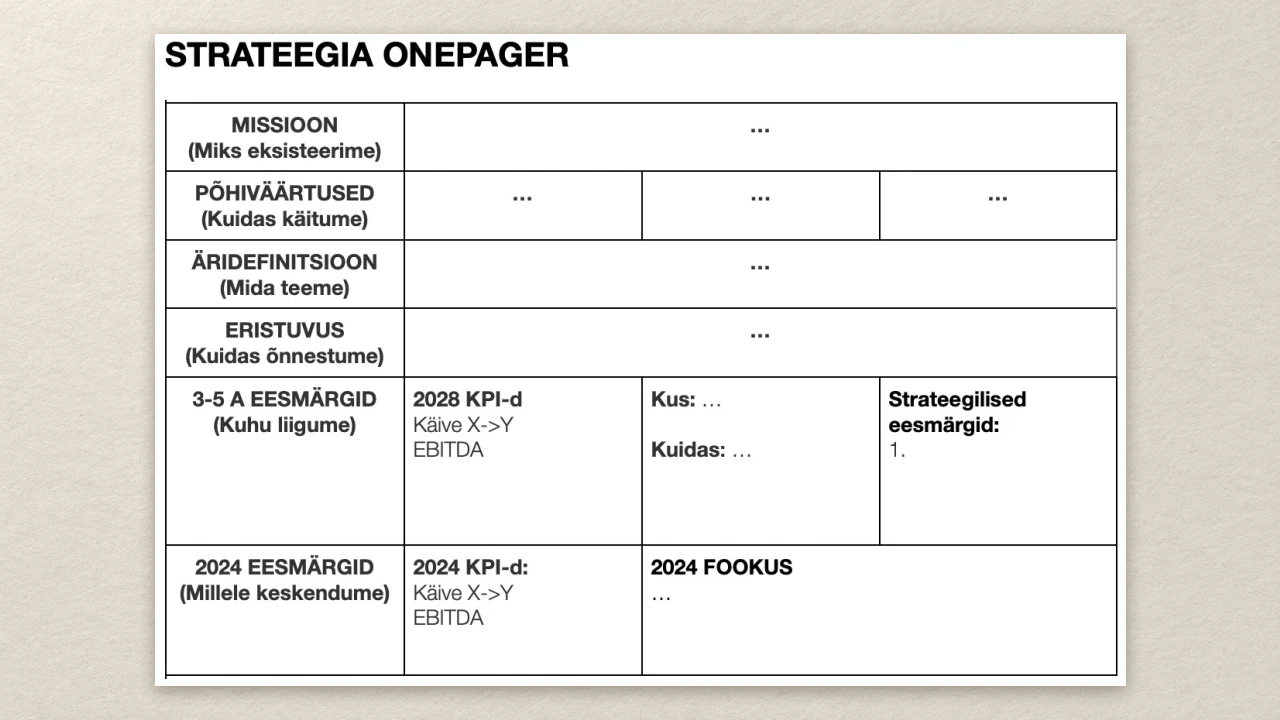
I recommend that leaders clarify the following seven points. They may seem familiar, but it is unusual to find them stated both clearly and briefly.
- Mission: why do we exist? I have seen organisations write a mission merely to tick a box on their website or in a corporate presentation. The result often says little and inspires no one. The mission should be ambitious and idealistic and make people’s lives significantly better in some way. It should be one of the main reasons to come to work in the morning.
- Core values: how do we behave? Successful organisations follow three or four principles that guide day-to-day behaviour and decisions. The aim is to identify the few behaviours that make this particular business successful, rather than write a generic code for the intranet. Values describe the organisation, help recruit the right people and recognise a poor fit, guide decisions, and give managers something useful to discuss at quarterly performance reviews.
- Business definition: what do we do? This is probably the simplest of the seven. Describe what the organisation does in one sentence. It should pass the grandmother test without relying on marketing slogans. For example, my company, Sikka Training & Consulting, runs leadership programmes that help organisations achieve their most important goals.
- Differentiation: how do we succeed? This is usually the hardest question, and often the least explored. Ask colleagues what makes your company or team different. Do their answers even match? Differentiation consists of a set of choices that help the organisation grow and distinguish itself from competitors. Describe how you deliver products or services in a way that would be almost impossible to copy. Apple and its closed ecosystem are an example.
- Three- to five-year strategic goals: where are we going? Describe where you want to take the organisation in the longer term. What will help you achieve those goals? What will you build on?
- What is the focus for the next three to twelve months? Agree on one or two priorities with the most influence on your strategic goals. I recommend avoiding revenue or profit targets as the focus here. Focus on what will actually help revenue and profit grow. Then align the rest of the organisation around those priorities.
- Business as usual: standard operating measures. Describe the goals and measures that matter for everyday operations. These might include revenue, costs, customer and employee satisfaction, quality measures and website visits.
Put these seven points on one page, no more than a single sheet of A4. Points one to five apply to everyone in the organisation, while six and seven vary by team or individual. It is useful when recruiting: give candidates the one-page strategy and talk them through the direction and goals of both the organisation and the particular team.
Two final observations from experience. The purpose is to create clarity for the organisation; marketing slogans do little for that. And this material is a work in progress. Instead of pursuing perfection, use the best understanding you have today of the past, present and future. A good plan executed well today is better than a perfect plan executed next week.
If you think I could help you or your organisation build a strategy and follow through on your priorities, get in touch.
Three books that have inspired me on this subject are Built to Last by Jim Collins, The Advantage by Patrick Lencioni and Scaling Up by Verne Harnish.