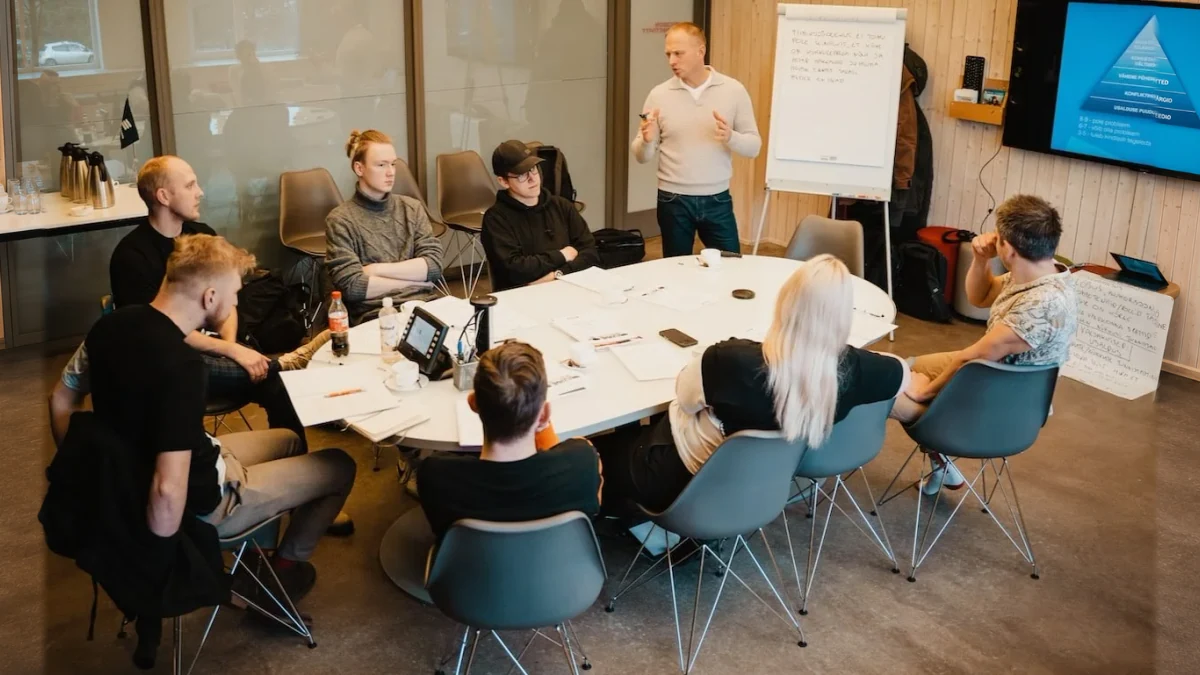
I run a variety of team workshops. Before we start, it helps to understand how effectively the team works together. Below is a simple ten-minute assessment you can use with any team at any time.
Let’s start by defining a team, because not every group has to be one. A team is a relatively small number of people, around four to six, who share a goal, the benefit of achieving it and responsibility for doing so. Team members are willing to give up personal benefits for the good of the team.
To try this with your team, set aside at least an hour together. Briefly explain Lencioni’s teamwork model. Give everyone about ten minutes to answer the questions below and add up their own results. As the leader, you can then calculate the arithmetic mean to find the team score. Discuss your strengths, the challenges you face and how you want to address them.
Teamwork questionnaire
Rate how often each statement applies to your team: 1 — rarely, 2 — sometimes, 3 — often.
- Team members debate passionately and do not hold back their views.
- Team members point out one another’s shortcomings and unproductive behaviour.
- Team members know what colleagues are working on and how they contribute to the collective good.
- Team members apologise quickly and sincerely when they say or do something inappropriate or potentially harmful to the team.
- Team members readily make sacrifices in their own areas for the good of the team. Team results outweigh individual comfort and achievement.
- Team members openly acknowledge their weaknesses and mistakes.
- Team meetings are interesting rather than boring.
- People leave meetings confident that colleagues are fully committed to the decisions made, even when they initially disagreed.
- Missing a team goal has a significant effect on team morale.
- Even the most important and difficult issues are tackled in team meetings so people can solve them together.
- Team members are determined not to let their colleagues down.
- Team members know about one another’s personal lives and feel comfortable talking about them.
- Team members end discussions with a clear resolution and a specific plan of action.
- Team members challenge one another’s ideas, plans and actions.
- Team members are slow to seek credit for their own contributions and quick to notice and recognise those of others.
Download the full questionnaire and scoring guide (PDF, in Estonian).
If you’d like help improving your team’s effectiveness, get in touch.
“If you see that your desired organisational changes are not happening as they should, call Eero for help!”
 Igor RõtovCEO of Äripäev
“If you’re looking for more organisational clarity and execution speed in what matters most, then I recommend Eero for help. In collaboration with Eero the bottom-line results really do start improving, but it requires that you yourself as a leader are up for the challenge.”
 Valdur Laidchair of UG Investments and Director General of the Estonian Tax and Customs Board
“Eero helped me see how I had become the glass ceiling slowing the organisation’s development, how to get past it and how to stay at my best in a healthy way. A powerful experience I wouldn’t have known how to appreciate before going through it.”
 Ats Albreboard member, Nortal